Monday, January 19, 2009
Two things at this time in the morning are worth blogging about. Without any bullshitting, here they are.
1. The Goodwill Logo. I never noticed this before! (found on Digg)
 Holy crap! That blew my mind for a little bit. But, with minimal B.S., onto the next topic.
2. Beating 3-card solitaire makes me extremely happy. I finally remembered to capture that moment of happiness so I can relive it later.
And, I learned how to upload to YouTube in HD. Yes, you just watched the ending sequence of solitaire in high def.
Ah, a pleasing post. Refreshing.
Friday, January 16, 2009
Well, I was writing a blog post, and instead of saving I just banked on leaving my Writer window open. Then I accidentally pulled the plug on my laptop without having the battery in. Which leaves me with this and a problem of forgetting what I was writing about.
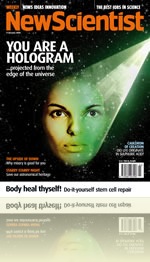 First, while I have most reader’s attention, how about a claim that our universe could be fundamentally 2-D? A theory has stated that we could be living holograms reflected off of the fundamental 2-D waves of our universe. I love this stuff. It seems so far out there, but for those who keep open minds to even the most preposterous of things (as long as evidence is available, not something like religion, etc.) this is some fun stuff. Let me know what you think about this finding; I love discussions on this type of stuff!
The article that I linked to talks in great detail on this possibility; it is a fun read if nothing else.
Moving on, I think I will talk about my two philosophy classes this semester. Bear in mind that I do not have many talking points on these topics, as I have not previously been too in-depth with them. The first one that I am excited about is Modality. This will concern modal logic and trying to conclude, by appealing to alternative possible worlds, the necessity or possibility of certain apparent-truths or falsities. (I think that is a good way of putting it.)
The second class I am excited about is Philosophy of Language. The following proof is one of the more commonly found intro-day-stumpers as provided by the professor:
1. Nothing is better than happiness.
2. A sandwich is better than nothing.
∴ 3. A sandwich is better than happiness.
Now, we all can see that something is wrong there, but how can that be represented? The word nothing is stationary, but it seems to bring implications with it. Based on my extremely limited knowledge on this topic, I think that this distinction does come from the implications of nothing, i.e. “Nothing (that is good) is better than happiness,” and, “A sandwich is better than nothing (to eat).” But, I’m not sure if I can make a simple distinction like that or not.
This should be a fun time this semester. No sarcasm. (Seriously!)
Wednesday, January 7, 2009
In typical intertube-browsing-fashion, I happened to stumble on a blog full of ideas I do not agree with. Who is this latest perpetrator that prompts a blog post from me? Her name is Denyse O'Leary, and she doesn't believe in magic.
And suddenly, the penny dropped. What he meant was that I just don't believe in magic [regarding understanding how natural selection works]. I can't make myself believe in magic; I haven't been able to since I was a child.
Yes. Natural selection is magic. Wizardry is responsible for the changes seen in population of animals well-suited for their environment. However, there is no response to this woman; this is demonstrated in her next great quote. Mind you, I try to quote a large amount of text to undoubtedly demonstrate her irrational thought process.
As a traditional Catholic, I am asked to believe in the Virgin Birth of Jesus Christ. But I am not asked to believe in virgin birth as a general proposition, and especially not for human males whose mothers' pregnancies could be readily - though not respectably - accounted for otherwise. In that one instance, I am told, I cannot argue that "God wouldn't have done it that way," as I have no basis for arguing with God about what he would or wouldn't have done as an intentionally unique, divinely ordained event.
Ah, the age-old response. A virgin birth is not magic. Why? Apparently this is because she is not asked to believe in this as a general proposition, so it simply a one-time act from a three-omni God. The reply to this is simple, as given by Mylan Engel, Jr. (his co-authored blog found here), and elicits the BOK-maneuver reply. Granted, Engel uses this reply to combat the response to the evidential problem of evil. But, it applies here as well.
If Denyse believes that she ought to believe in this virgin birth, this one instance because she was told to, then she agrees that what God does is beyond her ken. If God is able to perform actions that are completely beyond our ken, then it is true that we can never know the way God works, or his intentions of such actions. If we can never know God's intentions or ways of acting, then we are in no position to understand anything God does. If we cannot understand anything God does, and view everything, or even some things, as intentionally unique, divinely ordained events, then we are in a futile position. Why a futile position? Let me explain. Denyse is trusting what she is told and accepts what God does since it is beyond her ken. Now, when Denyse (not to be rude, but it is inevitable) dies, she may or may not appear in heaven. Assume she does. In heaven, God looks at her and shakes His head. "Denyse, you helped starving children, you raised children and were extremely virtuous. But... I hate to tell you this... I actually condone the starvation of children, the abandonment of children and acting vile. So, off to hell with those other do-gooders!" Denyse cannot argue with God. All He has to reply with is that what He does is beyond Denyse's ken.
If you think you know that God commends your actions, then it looks like that virgin birth is pretty magical after all.
Tuesday, January 6, 2009
Tax cuts are excellent for a politician's campaign and time in office for two main reasons. First, promises (and follow-through) on tax cuts brings a temporary optimism for those who are in the middle class and below. Paying less to a government, which presumably is being chastised for something unrelated and thus allowing for union of the underpaid masses with the higher paid individuals, excites members of a society. Excitement allows for both a politicians (re)election and for a short-term smooth-sailing ride. This leads into the second reason. When the population begins to question the state of the society, in terms of smart spending and observable improvements, the politician has a fast reply. Just as a mother would tell her insistent child, the tax-cutter is able to claim that there is no money to be spent!
Now start this vicious cycle again. You see there is a need for taxing, but you have promises of tax cuts due to a poor economy. Promises of tax cuts excite, unite and deliver a candidate. Luckily, or at least I hope, new tax policy in this new year will allow for both the cuts needed to move the economy along while also promoting a more beneficent attitude from those who are not as bad off.
I understand this is all well know, i.e. you cannot reduce taxes all the time and still have a thriving state. Perhaps I am simply doing some publicized anticipation of what can needs to happen in the future for this country.

 Posts
Posts

