Monday, March 2, 2009
[I’ve been looking at this for awhile, and it may not even be an interesting topic anymore, but I decided I would have a quick attempt at working through it. This was mostly done in a wrote this on a cocktail napkin fashion, as well. Comments and criticisms would be great, too!]
I’d like to suggest that time is not infinite, and, in fact, “infinity” should not be used practically, but only theoretically.
Let a=1/3 and b=.33… (where ‘…’ indicates repeating to infinity).
1/3=.33…
a=b
3(1/3)=1
3(.33…)=.99…
3(a)=1
3(b)=.99…
a does not equal b, after a simple multiplication. (I understand this can be shown with limits as well.) But a=b seems obviously and necessarily true.
So, .99… = 1 seems like it must be true somehow.
With a set containing an infinite set of numbers, it is represented by the infinity symbol.
With a set containing an infinite set of time places, I will represent it with St0-tn.
How is it ok to represent infinite time like this?
“Infinity” is an abstract conception. So, this can be an abstract confession as well; we can see how it is possible to represent and split infinity into parts.
First, in common usage, one typically has no problem mentioning “half an hour” or “36.48 seconds”. Time has been indexed at a certain point in one case, and has been split in the other case.
The following diagram will be used in the proceeding paragraph as tool to demonstrate another supporting reason.

The red line represents an infinite area of measurement. The blue line represents a line splitting the infinite area of measurement. And the green line represents the new infinite are of measurement. Eventually, since the infinite area can be split, an infinite area will eventually decrease to a .00…1 where it would eventually become 0 (by the same principle as demonstrated earlier).
So, we can now say this:
(St1/3^ St1/3^ St1/3)=St0-tn
(St.33…^ St.33…^ St.33...)=St0-tn
The latter suggests infinite time while the former suggest a finite time.
How do we decide?
To have infinite time, we’d have to accept that a does not equal b, i.e. 1/3 does not equal .33…). However, a=b seems obvious and necessary.
Infinity is simply a notion that should be used only in theorizing, and rarely, if at all, in practical application.
(I’d also like to note that this fits perfectly with a deterministic view of things, which can be for a different time.)
Friday, January 16, 2009
Well, I was writing a blog post, and instead of saving I just banked on leaving my Writer window open. Then I accidentally pulled the plug on my laptop without having the battery in. Which leaves me with this and a problem of forgetting what I was writing about.
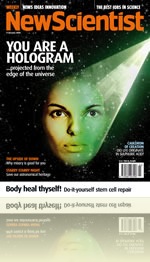 First, while I have most reader’s attention, how about a claim that our universe could be fundamentally 2-D? A theory has stated that we could be living holograms reflected off of the fundamental 2-D waves of our universe. I love this stuff. It seems so far out there, but for those who keep open minds to even the most preposterous of things (as long as evidence is available, not something like religion, etc.) this is some fun stuff. Let me know what you think about this finding; I love discussions on this type of stuff!
The article that I linked to talks in great detail on this possibility; it is a fun read if nothing else.
Moving on, I think I will talk about my two philosophy classes this semester. Bear in mind that I do not have many talking points on these topics, as I have not previously been too in-depth with them. The first one that I am excited about is Modality. This will concern modal logic and trying to conclude, by appealing to alternative possible worlds, the necessity or possibility of certain apparent-truths or falsities. (I think that is a good way of putting it.)
The second class I am excited about is Philosophy of Language. The following proof is one of the more commonly found intro-day-stumpers as provided by the professor:
1. Nothing is better than happiness.
2. A sandwich is better than nothing.
∴ 3. A sandwich is better than happiness.
Now, we all can see that something is wrong there, but how can that be represented? The word nothing is stationary, but it seems to bring implications with it. Based on my extremely limited knowledge on this topic, I think that this distinction does come from the implications of nothing, i.e. “Nothing (that is good) is better than happiness,” and, “A sandwich is better than nothing (to eat).” But, I’m not sure if I can make a simple distinction like that or not.
This should be a fun time this semester. No sarcasm. (Seriously!)

 Posts

